
When ACMA blocks an offshore casino website, Australian players often have immediate questions. Is the casino gone? Is an active account balance lost? Can a pending withdrawal still arrive? Does a new casino link make the service safe? And what do payment methods, KYC checks, VPNs, and BetStop mean in this situation?
The most important point is simple: an ACMA website block is a warning that the service has been found to be operating in breach of Australia’s interactive gambling rules. It is not a signal to search for alternative links, mirror domains, or technical workarounds.
Offshore casino gambling carries practical risks that are easy to miss before a deposit. These include limited consumer protections, uncertain dispute options, changing website addresses, delayed verification checks, payment restrictions, and unclear withdrawal processes. A professional-looking site, a large game library, or a promise of fast payouts does not remove those risks.
This guide explains what an ACMA block means for Australian players, what to do if you have an existing account, how KYC and payment methods affect withdrawals, why VPN use can cause serious account problems, and where BetStop fits into responsible gambling. For more hints, tips and tricks visit casinoa.org pokies guide that deep-dives into gambling related issues.
What an ACMA Block Means
ACMA is responsible for enforcing Australia’s online gambling rules under the Interactive Gambling Act 2001. Online casino-style services, including online pokies, roulette, blackjack, and online poker, are prohibited from being provided to people in Australia.
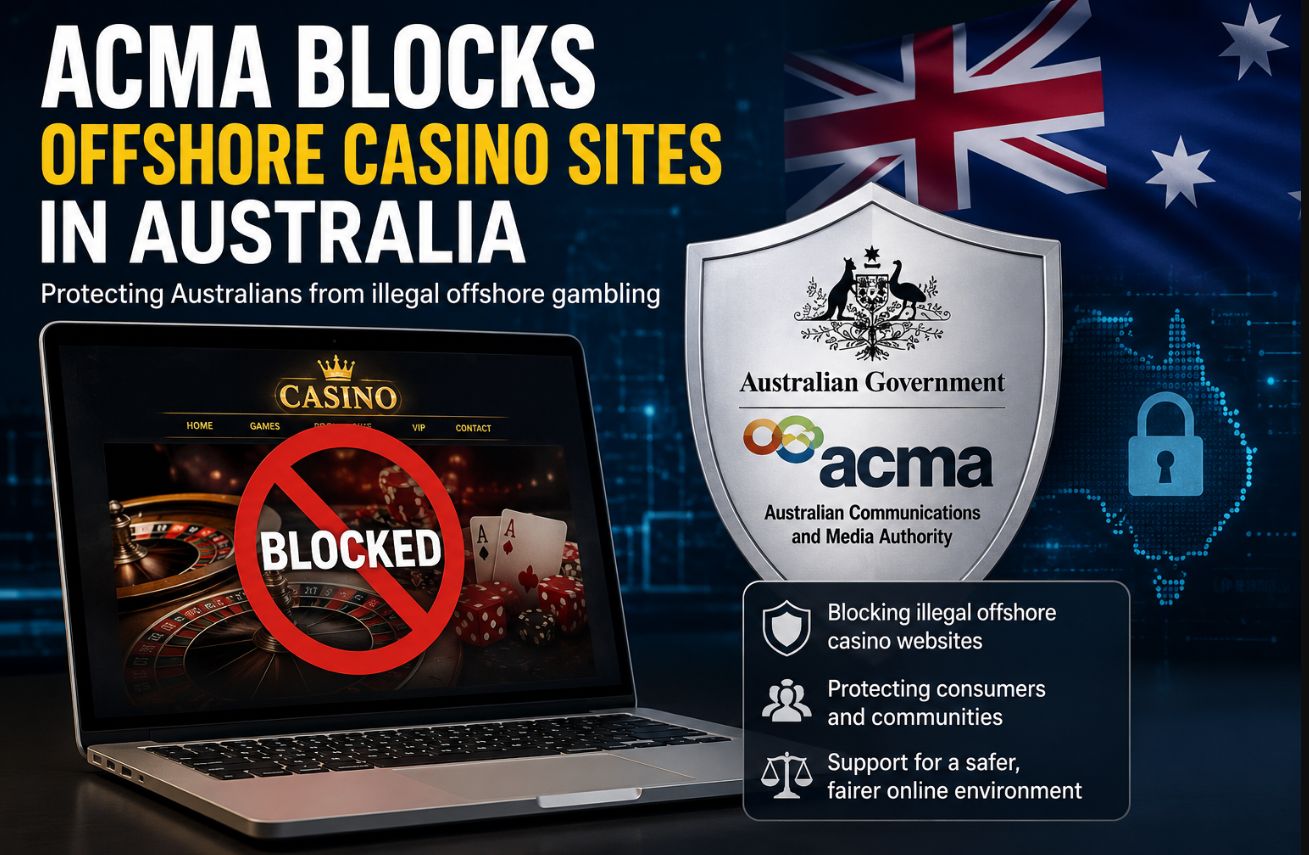
When ACMA identifies a service that breaches these rules, it can ask Australian internet service providers to block the website. The result is usually a blocked-page notice or an unavailable website when accessed through an Australian internet connection.
An ISP block does not necessarily mean the operator’s servers have disappeared. The casino may still operate outside Australia, retain player records, process payments in other jurisdictions, or use different domains. However, none of this makes the service lawful for Australians or gives players the protections they would expect from an Australian-regulated provider.
A blocked casino may also have affiliate sites, duplicate domains, or lookalike pages. Some are operated by the original brand, while others may be unrelated phishing sites designed to capture login details, documents, or payment information.
For players, the safest interpretation is straightforward: if ACMA has blocked the service, treat it as a serious risk signal and do not attempt to keep gambling through replacement links.
Is It Illegal for a Casino to Target Australians?
Australia’s interactive gambling rules focus on providers. It is prohibited for online casino-style gambling services to be provided or advertised to people in Australia.
This includes offshore companies that may hold a licence in another country. A foreign licence does not authorise an online casino to offer prohibited casino games to Australian customers.
That distinction matters because players often assume that a licence badge, a registered company name, or a familiar payment method proves the casino is approved in Australia. It does not. A casino can be licensed somewhere else and still operate in breach of Australian rules when it targets Australians with prohibited services.
The legal position also affects consumer protection. If a player has a dispute with an offshore casino, there may be no Australian regulator, ombudsman, or dispute-resolution body that can force the operator to return funds. The operator may be located overseas, use foreign payment processors, and apply terms written under another jurisdiction.
This is one reason ACMA repeatedly warns Australians about offshore casino services. The risk is not limited to losing a bet. It includes unclear ownership, difficult withdrawals, poor customer support, identity-theft risks, and a lack of practical recourse if the operator refuses to pay.
What You Can Do After a Site Is Blocked
If you have never used the casino, the safest response is to move on. Do not register through a new address, do not follow social-media links, and do not trust messages claiming that the casino has “moved” to a new website.
If you already have an active account, balance, or pending withdrawal, take a calm and evidence-based approach.
First, collect your records. Keep copies of deposit receipts, bank or wallet transaction references, screenshots of the balance where available, withdrawal confirmations, chat transcripts, account emails, and the relevant terms and conditions.
Second, check your email and account notifications carefully. An operator may send messages about a pending withdrawal, a verification request, or account restrictions. Do not click unfamiliar links automatically. Phishing emails often use urgency to make people act without checking the sender.
Third, use only established contact channels that you can independently verify. If you previously received legitimate account emails, compare the sender domain closely. If the contact details suddenly change, or a person on social media asks for identification documents, passwords, crypto transfers, or a new deposit, stop.
Fourth, request a written position from the operator. Ask it to confirm the balance recorded on the account, the status of any withdrawal, whether KYC is incomplete, and whether it has a process for resolving existing Australian customer balances.
Finally, do not deposit more money. A casino should not require a new deposit to release a previous withdrawal, remove a withdrawal block, pay a tax charge, or verify that you own an account. Those demands are major red flags.
Does an ISP Block Remove Your Balance?
An ISP block normally affects access to a domain, not the casino’s internal account database. In technical terms, a casino’s player balances, betting history, verification files, and payment records are usually stored on the operator’s servers rather than inside the Australian ISP’s blocking system.
That means a block does not automatically erase an account balance. A pending withdrawal may still be processed, and the casino may still retain a record of the money in the account.
However, a recorded balance is not the same thing as protected money.
When funds sit inside an offshore casino account, the player depends on the operator to honour a withdrawal request. If the operator becomes unresponsive, closes Australian accounts, changes payment providers, or alleges a terms breach, the player may find it difficult to recover the balance.
The correct approach is neither panic nor false confidence. Do not assume the money has vanished because the website is blocked. But do not assume the money is guaranteed simply because the balance may remain on the casino’s system.
Document the amount, request a clear written response, and do not make additional deposits while the situation is unresolved.
Why VPN Use Creates More Risk
A VPN can change the visible location of an internet connection. It does not make an offshore casino lawful for Australian use, remove the operator’s country restrictions, or guarantee that an account will pass a withdrawal review.
Many casinos have terms that restrict the use of VPNs, proxies, location-masking tools, or access from certain countries. Even where those terms are poorly displayed, a casino may later rely on them during a withdrawal dispute.
The problem is account consistency.
A casino can compare multiple data points when it reviews an account. These may include account registration details, IP address history, device information, login patterns, payment-method information, identity documents, and proof of address.
If a player’s location signal conflicts with their address, ID, bank account, or payment records, the casino may request additional verification. It may freeze the account, delay the withdrawal, or claim that the player breached its terms.
Using a VPN can also expose players to extra scam risk. Search results and VPN-focused casino pages may promote replacement domains that have no confirmed connection to the original operator. A player worried about a blocked balance may be more likely to share a password or upload an ID document without proper checks.
Do not use VPNs, mirrors, or alternate access methods to bypass an ACMA block. They can create legal, security, and withdrawal problems without solving the core issue.
KYC: Why Verification Often Appears at Withdrawal Time
KYC means Know Your Customer. It is the identity-verification process used by gambling operators and payment services to confirm who a customer is.
At an offshore casino, KYC is often requested when a player first tries to withdraw. Some casinos request documents at registration or before a first deposit, but others allow deposits and betting before requiring verification.
This can be frustrating. A player may deposit easily, win money, submit a withdrawal, and then be asked for a passport, driver licence, proof of address, payment-method evidence, or a selfie.
Typical KYC requests may include:
-
Government-issued photo identification
-
Proof of residential address
-
A bank statement or utility bill
-
Evidence that a payment method belongs to the account holder
-
A screenshot from an e-wallet account
-
A partially masked image of a payment card
-
A selfie or video identity check
-
Source-of-funds documents for larger activity
Verification does not always mean the casino intends to withhold funds. Legitimate checks can help prevent fraud, account takeover, underage gambling, and money laundering.
The problem is that offshore casino KYC can be inconsistent. A player may be asked for the same document more than once, receive conflicting instructions from support, or find that a document is rejected without a clear explanation.
To reduce avoidable delays, use accurate details when creating an account. The name, date of birth, address, and payment method should match the documents supplied. Never use someone else’s card, wallet, or bank account. Never alter documents.
If an operator asks for documents after an ACMA block, be especially cautious. Only submit documents through a verified official support channel. Do not upload sensitive information through an unfamiliar replacement site.
Do Fast Payout Claims Mean a Casino Is Safe?
No. “Instant payout,” “same-day withdrawal,” and “fast cashout” are marketing terms, not guarantees.
A payment can only move quickly after the casino has approved it. The real delay often occurs before the payment stage, when the operator reviews KYC documents, checks wagering requirements, investigates a payment mismatch, or applies a withdrawal limit.
A casino can advertise instant withdrawals while still holding a cashout for days or weeks in a pending queue.
Before relying on a claimed payout speed, consider these questions:
-
Does the casino state a separate processing time before payment is sent?
-
Is KYC required before the first withdrawal?
-
Does the casino impose daily, weekly, or monthly withdrawal limits?
-
Are bonus winnings subject to a maximum cashout rule?
-
Does the payment method have its own approval, transfer, or conversion delays?
-
Does the casino cancel pending withdrawals after a certain time?
-
Is the advertised payout speed based on real-money withdrawals or only internal approval?
Fast payments are not a substitute for transparency. A casino that clearly states its withdrawal process, verification requirements, and limits is less risky than one that simply uses the word “instant.”
PayID and Casino Payments
PayID is an Australian payment addressing service that can link payments to a mobile number, email address, Australian Business Number, or organisation identifier. When used through participating financial institutions, it can make bank transfers easier and faster.
However, PayID does not turn an offshore casino into a legal Australian gambling provider. It also does not guarantee that a casino withdrawal will arrive instantly.
There are two separate stages:
-
The casino approves the withdrawal.
-
The payment is sent through the available payment channel.
PayID may make the transfer stage fast once money has been released by the operator. But the operator’s internal approval process can still take time. If a casino has not completed KYC, is reviewing bonus activity, or is applying a withdrawal limit, PayID cannot bypass that delay.
Players should also be alert to PayID scams. A legitimate incoming PayID payment does not require a player to send money first, pay a release fee, or disclose online banking credentials. A request to “upgrade” a PayID account, send a verification payment, or share a banking code is a serious warning sign.
When a gambling site is blocked or operating offshore, the safer question is not “Can it pay through PayID?” It is “What consumer protection exists if it does not pay at all?”
E-Wallets and Withdrawal Convenience
E-wallets can act as an intermediary between a player’s bank account and an online merchant. Depending on the service, they may offer a separate balance, payment history, and a way to avoid sharing bank card details directly with every website.
For gambling transactions, e-wallets can appear convenient because deposits may be fast and withdrawals may arrive sooner than traditional bank methods once the casino approves them.
But convenience should not be confused with protection.
An e-wallet provider may have its own verification requirements, transaction limits, currency-conversion fees, account reviews, and restrictions on gambling-related payments. Some casino sites accept a wallet for deposits but do not offer it for withdrawals. Others require players to withdraw back to the same method used for the deposit.
Players should check:
-
Whether the wallet is available for both deposits and withdrawals
-
Whether the account name matches the casino account name
-
Whether the provider permits gambling-related transactions
-
Whether currency conversion applies
-
Whether there are withdrawal, transfer, or inactivity fees
-
Whether the casino has separate cashout limits
-
Whether the casino requires KYC before an e-wallet withdrawal
An e-wallet does not prevent an offshore casino from delaying or rejecting a withdrawal. It only changes the route used after the casino has approved the transaction.
Crypto: Speed, Privacy, and Major Risks
Cryptocurrency is often promoted by offshore casinos as a fast and private way to deposit and withdraw. Transfers can take place outside traditional card networks, and some crypto payments can be processed around the clock.
However, crypto carries substantial risks, especially when combined with an offshore gambling operator.
Crypto transactions are generally irreversible. If funds are sent to the wrong address, sent to a scam website, or paid as part of a fake “withdrawal release” demand, recovery may be impossible.
Crypto prices can move quickly, which means the value of a balance can change between deposit, withdrawal approval, and conversion back into Australian dollars. Network fees can also vary. A casino may support one blockchain network but not another, and using the wrong network can create a permanent loss.
Privacy is also often overstated. Many offshore casinos still require KYC checks before withdrawals, even if they accept crypto deposits. A casino may advertise “no KYC” at signup, then request identity documents after a large withdrawal or unusual account activity.
Crypto does not make an offshore casino safer. It may be fast after approval, but it also removes some of the dispute options that cardholders and bank customers may have when something goes wrong.
Never send cryptocurrency to unlock a casino withdrawal, pay an account activation charge, cover a supposed tax bill, or prove ownership of a wallet. These requests are common scam patterns.
Responsible Gambling Matters Most
The financial risk of offshore casino gambling is only one part of the issue. Online casino products are designed for frequent, fast, and repetitive play. They can make it easy to lose track of time, spending, and emotional decision-making.
A blocked website can trigger urgency. A player may feel pressure to recover an account balance, chase a previous loss, or immediately find another casino. That is exactly when it helps to stop and take a step back.
Useful harm-minimisation habits include:
-
Set a fixed entertainment budget before gambling.
-
Never use rent, bills, savings, or borrowed money.
-
Do not chase losses with larger bets or extra deposits.
-
Take breaks after a loss or a long session.
-
Avoid gambling when stressed, tired, upset, or under the influence.
-
Review bank statements and payment history regularly.
-
Remove saved card details from gambling accounts.
-
Use bank gambling blocks or transaction controls where available.
-
Speak to someone early if gambling feels difficult to control.
If gambling is causing financial stress, relationship pressure, secrecy, debt, anxiety, or repeated failed attempts to stop, professional responsible gambling support is available.
What BetStop Covers — and What It Does Not
BetStop is Australia’s National Self-Exclusion Register. It is a free government service that allows a person to self-exclude from all licensed Australian online and phone wagering providers in one process.
After registration, covered providers must not allow the person to open new wagering accounts, place bets, or receive direct marketing. Existing accounts with credit balances must be closed and any remaining credit returned according to the scheme’s rules.
BetStop is an important protection for people who want a strong barrier against licensed Australian wagering services.
However, BetStop does not cover illegal offshore online casino services. This is a crucial limitation. An offshore casino that is already operating outside Australia’s legal framework may not check the register, honour a self-exclusion, close an account, or stop marketing messages.
That does not make BetStop less valuable. It means players may need more than one protection.
A broader support plan can include:
-
Registering with BetStop for licensed wagering services.
-
Contacting banks about gambling transaction controls.
-
Using blocking software on devices.
-
Unsubscribing from casino marketing messages.
-
Asking a trusted person to assist with financial limits.
-
Speaking with a free gambling counsellor.
-
Seeking financial counselling if gambling has caused debt.
Self-exclusion is not a punishment. It is a practical tool for creating time, distance, and protection when gambling no longer feels manageable.
FAQs
What does it mean when ACMA blocks an offshore casino site?
It means ACMA has requested Australian internet service providers block access because the casino is considered to be operating in breach of Australia’s interactive gambling rules.
Is it legal for offshore online casinos to target Australian players?
No. Online casino-style gambling services, including online pokies, roulette, blackjack, and poker, are prohibited from being offered to people in Australia.
Can I still withdraw money from a blocked offshore casino?
A block does not automatically erase your account balance or cancel a pending withdrawal. However, the casino may be difficult to contact, and there is no guarantee that an offshore operator will process the payment.
Should I use a VPN or mirror site after ACMA blocks a casino?
No. VPNs and alternate domains can breach casino terms, create account-verification issues, increase phishing risk, and put a withdrawal at greater risk.
Why do offshore casinos ask for KYC documents?
KYC checks verify identity, age, address, and payment ownership. Casinos often request photo ID, proof of address, and payment evidence before approving a first withdrawal.
Do PayID, e-wallets, or crypto guarantee fast casino withdrawals?
No. These methods may transfer money quickly after a casino approves the withdrawal, but they cannot bypass KYC checks, pending reviews, bonus rules, or withdrawal limits.
Does BetStop block offshore online casinos?
No. BetStop covers licensed Australian online and phone wagering providers. It does not apply to illegal offshore online casinos or other gambling services that are illegally offered in Australia.
What should I do if gambling is becoming a problem?
Stop making deposits, consider registering with BetStop for licensed wagering services, ask your bank about gambling transaction controls, and contact Gambling Help Online on 1800 858 858 for free and confidential support.