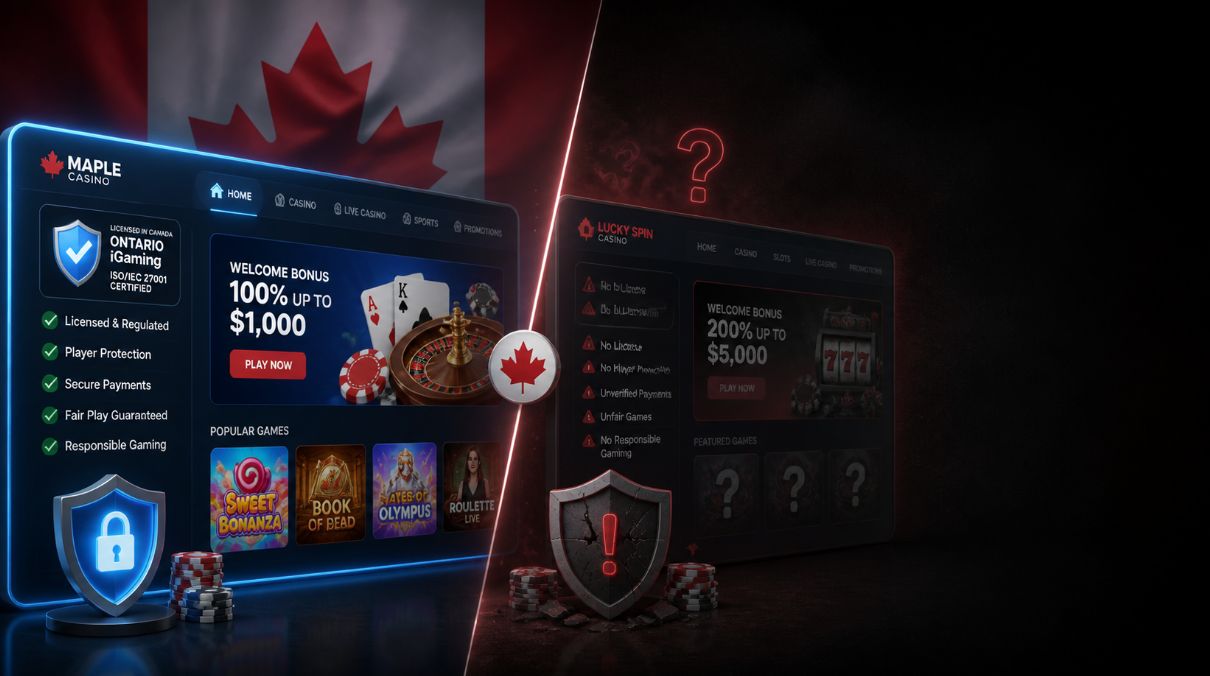
Licensed and unlicensed online casinos can look very similar on the surface, especially to Canadian players who are browsing international sites that accept CAD and Interac. The differences behind the scenes, however, are huge. They affect everything from the fairness of the games and the safety of your money to how easy it is to cash out your winnings.
What “Licensed” and “Unlicensed” Really Mean
When a casino is licensed, it holds a valid gambling licence from a recognized regulatory authority. That licence comes with rules the casino must follow on game fairness, player verification, anti-money-laundering measures, complaint handling, and responsible gambling.
A casino is unlicensed when:
-
It has no licence at all, or
-
It uses a fake or completely meaningless “licence”, or
-
It claims a licence from a body that does not actually regulate online gambling.
For Canadian players, this difference is crucial. A licence means an independent authority is watching the operator and can punish or shut it down for serious misconduct. Without that, the casino is essentially operating on its own promises.
Common Licensing Jurisdictions Canadians See
When you scroll to the footer of an online casino that accepts Canadians, you will often see one or more of these licensing authorities:
-
Government-run provincial regulators (for locally regulated platforms)
-
International regulators like Malta, Curaçao, Gibraltar, Isle of Man, or others
-
Occasionally, secondary authorizations for specific markets
Each regulator has its own standards. Some are stricter and more player-focused; others mainly ensure basic legality and tax collection. The key point is that a real licence is verifiable on the regulator’s official website, not just a logo on the homepage.
Unlicensed casinos typically:
-
Show no licence details at all
-
Display generic “certified” or “approved” badges with no link
-
Claim vague “international licence” wording without naming who issued it
If you cannot identify a real, named authority, you should treat the casino as unlicensed.
Why Licensed Casinos Are Safer for Canadian Players
From a Canadian player’s perspective, licensed casinos offer several concrete protections that unlicensed sites simply do not match.
1. Game fairness and RNG testing
Licensed casinos must use certified Random Number Generators (RNGs) and audited games. Independent testing labs verify that:
-
Slots and table games pay out according to their advertised RTP
-
Outcomes are random and cannot be manipulated mid-game
-
Game code and updates are reviewed regularly
In an unlicensed casino, there is no such obligation. The operator could, in theory, alter payout tables or rig outcomes without anyone checking. You have to trust their word alone.
2. Clear rules on withdrawals and bonuses
Regulators expect licensed casinos to publish clear terms and conditions for:
-
Deposits and withdrawals
-
Bonus wagering requirements
-
Maximum bet rules during bonus play
-
Dormant account policies
While disputes can still happen, at least you have written rules and a legal framework behind them. Unlicensed casinos may:
-
Change terms at short notice
-
Invent reasons to void winnings
-
Hide maximum withdrawal limits in vague wording
If a dispute arises at an unlicensed site, you effectively have nowhere neutral to turn.
3. Identity verification and anti-fraud measures
Licensed casinos must verify your identity (KYC checks) to:
-
Block underage players
-
Prevent fraud and identity theft
-
Meet anti-money-laundering obligations
Although KYC can feel inconvenient, it is a sign that the casino is following proper rules. Unlicensed sites sometimes:
-
Skip KYC entirely until you win big, then use it as a pretext to delay or refuse payouts
-
Accept obviously fake details without any checks
-
Fail to secure personal documents properly
For Canadian players sharing ID online, a regulated environment is much safer.
4. Dispute resolution and complaints
If you have a serious issue with a licensed casino—such as withheld winnings, unfair confiscation of balance, or unprocessed withdrawals—you can usually:
-
Contact the casino’s own complaints department
-
Escalate to an independent dispute resolution body where available
-
Report the casino to the licensing authority
The regulator may pressure the operator, mediate, or in extreme cases revoke the licence.
With unlicensed casinos, there is no external referee. Support might ignore you, close your account, or simply stop responding without consequences.
Why Some Canadian Players Still Use Unlicensed Casinos
If licensed casinos are safer, why do unlicensed sites attract Canadian players at all? There are a few common reasons.
1. Aggressive bonuses and offers
Unlicensed casinos often advertise:
-
Huge “no rules” bonuses
-
Extremely high match percentages
-
Cashback deals and VIP perks that sound too good to be true
Because they are not under strict regulation, they can promise almost anything in their marketing. The problem is that they can also refuse to honor those promises later, citing hidden terms or accusing players of “abuse.”
2. Fewer restrictions
Licensed operators usually have to follow responsible gambling rules such as:
-
Deposit limits
-
Self-exclusion systems
-
Advertising restrictions
-
Prohibitions on offering certain high-risk features
Unlicensed casinos may ignore these guidelines. For a player who wants unrestricted play, that can look attractive—but it also means less protection when things go wrong.
3. Lack of awareness
Some Canadian players simply do not realize the difference between licensed and unlicensed. If a site:
-
Looks professional
-
Accepts CAD and popular payment methods
-
Has many games and providers
it can feel legitimate. Without checking the licence, it is easy to mistake a high-quality but unregulated skin for a serious brand.
Risks of Playing at Unlicensed Casinos
The downsides of unlicensed casinos are not theoretical; they show up in very practical ways.
1. Withheld or delayed withdrawals
This is the most common complaint. Unlicensed casinos may:
-
Stall withdrawals with repeated document requests
-
Impose arbitrary “security checks” after you win
-
Set very low maximum withdrawal limits after the fact
-
Simply refuse to pay large wins with vague justifications
Because there is no regulator backing you, your chances of enforcing payment are extremely low.
2. Unfair or unclear bonus rules
At unlicensed sites, terms might:
-
Change after you claim a bonus
-
Be written in a way that allows the casino to interpret them however it wants
-
Include hidden clauses like “management decision is final” on all disputes
This means a bonus that looks generous can turn into a trap where your winnings are voided for tiny technical reasons.
3. Questionable game fairness
Without independent audits:
-
RTP could be lower than advertised
-
Progressive jackpots might not actually be funded properly
-
Games could behave differently for winning players
Most players will never be able to detect such changes in a small sample of spins, which makes it easy for bad actors to profit quietly.
4. Poor data protection
Unlicensed casinos may lack robust security around:
-
Payment details
-
Proof-of-ID documents
-
Personal contact information
In a worst-case scenario, this data could be mishandled, leaked, or sold. Licensed operators at least face reputational and regulatory consequences for such failures.
5. No meaningful responsible gambling tools
Where licensed casinos offer deposit limits, time-outs, and self-exclusion, unlicensed sites may:
-
Provide minimal or fake tools
-
Make it difficult to close your account
-
Continue marketing to you even after you ask them to stop
For Canadian players concerned about gambling harms, this is a serious drawback.
How to Check If a Casino Is Properly Licensed
Before depositing, Canadian players can take a few practical steps to assess a casino’s status.
1. Scroll to the footer
Most legitimate casinos show their licensing information at the bottom of every page. Look for:
-
The full name of the regulatory authority
-
A licence number or reference
-
Possibly a link to the regulator’s official site
If you see only generic badges like “Fair Play Certified” with no details, be cautious.
2. Verify on the regulator’s site
Many regulators provide a public search function where you can:
-
Enter the casino’s name or licence number
-
Confirm whether it is active and valid
-
See if there have been sanctions or suspensions
This extra step gives you confidence that the licence is not fabricated.
3. Check payment and provider partners
Well-known payment processors and reputable game developers generally prefer to work with licensed operators. If a casino:
-
Uses completely obscure payment brands only
-
Offers games from unknown or generic providers exclusively
that can be a sign it is operating on the fringes.
Licensed vs Unlicensed: Key Differences for Canadian Players
Here is a simplified comparison to highlight what Canadian players experience in practice.
When Could an Unlicensed Casino Ever Make Sense?
From a safety and fairness standpoint, unlicensed casinos are clearly riskier. Still, some experienced players choose them for specific reasons, usually after carefully weighing pros and cons.
Common motivations:
-
Niche game selections not yet available at licensed sites
-
Very high maximum bet or withdrawal limits in rare cases
-
Specific cryptocurrencies or payment methods not supported elsewhere
Even in these scenarios, Canadian players are essentially trading regulatory protection for freedom and novelty. For most players, this trade-off is not worth it, especially for long-term play or larger balances.
Practical Tips for Canadian Players Choosing Casinos
If you are a Canadian player deciding where to play, you can follow a simple checklist to stay safer:
-
Prioritize licensed casinos
Make licensing status your first filter, not an afterthought. -
Read terms before claiming bonuses
Focus on wagering requirements, game restrictions, maximum bet rules, and maximum cashout. -
Test support
Ask a question via live chat or email and see how professional and transparent the response is. -
Start small
Try a small deposit and a small withdrawal first. A reliable casino will process modest cashouts smoothly. -
Use responsible gambling tools
Set deposit or loss limits right away, even if you consider yourself disciplined. -
Avoid keeping large balances
Regularly withdraw profits instead of letting big sums sit in your casino account.
By following these steps, you reduce your exposure even further, even when dealing with licensed operators.
How Licensed Casinos Support Responsible Gambling in Canada
For Canadian players, another important difference lies in how casinos handle responsible gambling.
Licensed casinos usually:
-
Offer clear information about the risks of gambling
-
Provide contact details for national or provincial support services
-
Allow you to set personal limits on deposits, wagers, or losses
-
Offer self-exclusion tools, sometimes linked to broader regulatory schemes
Unlicensed casinos are less likely to invest in real responsible gambling infrastructure, and may even design their sites to encourage continuous, high-intensity play.
Final Thoughts: Choosing the Right Side of the Line
For Canadian casino players, the choice between licensed and unlicensed casinos comes down to one question: how much risk are you willing to take with your money, your data, and your time?
Licensed casinos:
-
Must follow structured rules
-
Are accountable to regulators
-
Offer a clearer path for resolving disputes
-
Provide better tools for safe and controlled play
Unlicensed casinos may dangle big offers and fewer restrictions, but they offer little recourse if something goes wrong. The short-term appeal of a huge bonus or relaxed rules rarely compensates for the long-term risk of unpaid winnings or compromised security.
If you want online gambling to stay fun, sustainable, and fair, choosing properly licensed casinos—and verifying those licences yourself—is one of the most effective decisions you can make as a Canadian slots player.